
The Trap of “Manual” Management: Why Your Business is Stalling
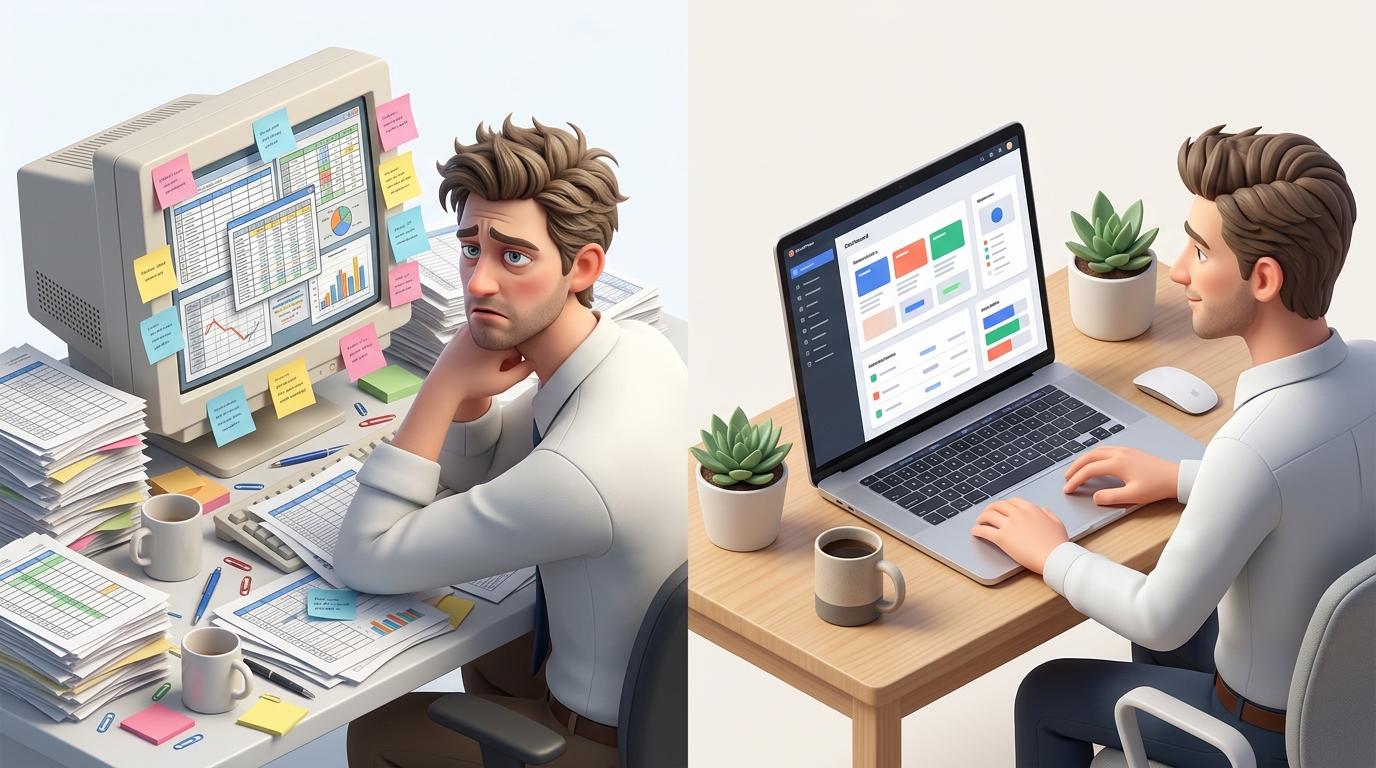
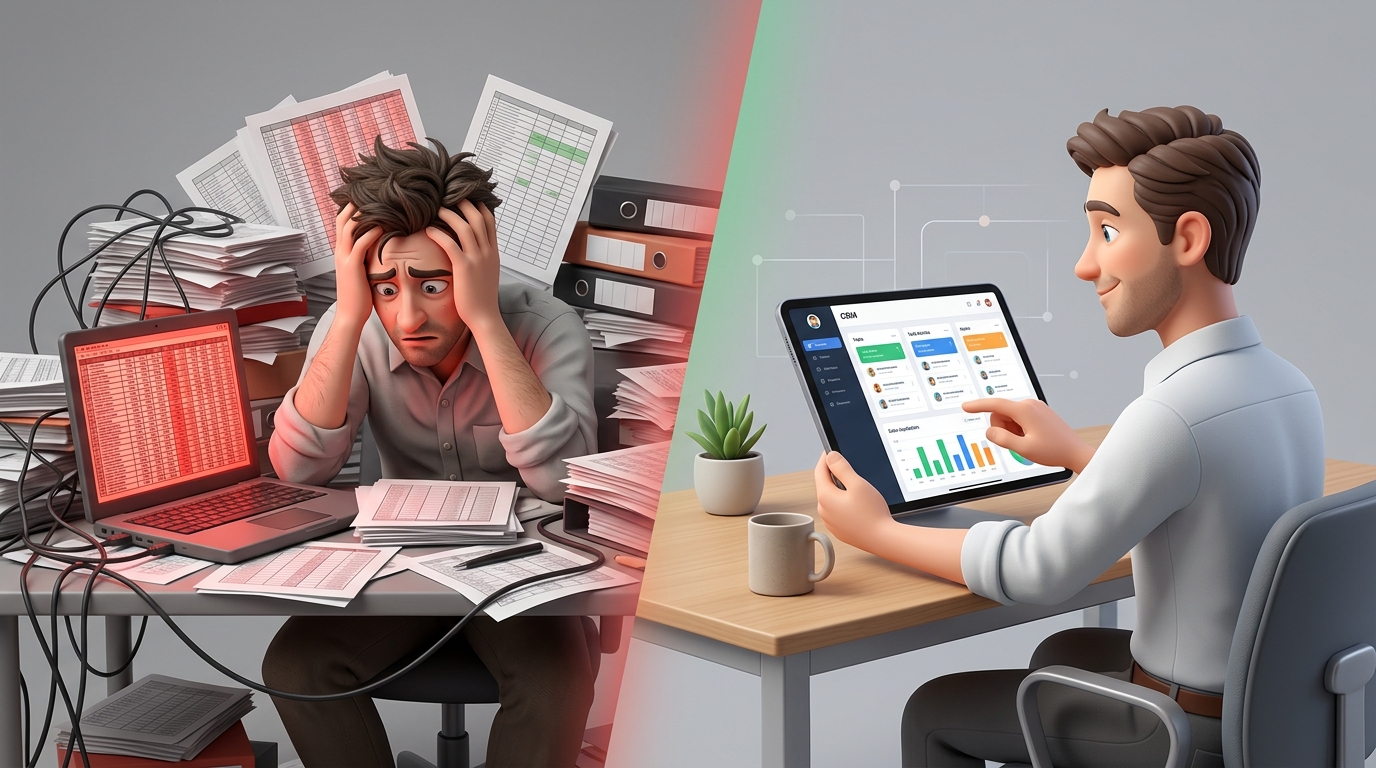
Imagine a typical morning for a company owner, let’s call him Alexander. Alexander built his business from scratch. At first, he answered calls himself, kept records in a notebook, and controlled procurement personally. The company grew, ten employees appeared, but Alexander still feels like he is the “bottleneck” in his own business. His morning starts not with coffee and strategic planning, but with dozens of Telegram messages: “Where is order #45?”, “Why wasn’t the client called back?”, “How much stock is left in the warehouse?”. He tries to keep everything in his head or in endless Excel spreadsheets that constantly “crash” or are filled with errors.
This is a classic situation where a business has outgrown manual management but has not yet transitioned to a systematic one. The main problem here is not lazy employees, but the fact that business automation is absent as a class. People are forced to do the work of robots: copying data from one table to another, remembering deadlines, and manually issuing invoices. The result is burnout, lost clients, and zero growth. In this article, we will look at exactly where in a business a system is vital and where the human factor is your main advantage.
System Territory: What Should Be Handed Over to Algorithms
A system is not just a computer program. It is a set of rules and tools that work seamlessly 24/7, without lunch breaks or bad moods. The main task of the system is to free your employees’ brains from routine. If a task is repeated more than three times a day and has a clear algorithm — it should be performed by a system.
1. Data Collection and Storage
A human is a forgetful creature. A manager might forget to enter a client’s phone number into the database or make a mistake in one digit. For a system, this is impossible. A modern CRM for business automatically records every inquiry from the website, Instagram, Facebook, or a phone call. You no longer lose leads because “someone forgot to write it down.”
2. Calculations and Reporting
How much time does your accountant or financial director spend on compiling a monthly report? If it takes more than 15 minutes — you have a problem. A system can generate reports on profits, losses, warehouse balances, and manager efficiency in real-time. You see the numbers here and now, not two weeks after the end of the month when it’s already too late to make decisions.
3. Deadline Control and Reminders
“Oh, I forgot to call the client back” — this phrase costs companies millions of hryvnias every year. A system does not forget. It will set a task for the manager, send a reminder to the messenger, and if the task is not completed on time, notify the supervisor. This is process optimization, which makes a business predictable.
- Automatic invoicing and payment control.
- Sending SMS or email notifications about order status.
- Distribution of inquiries among available managers.
- Generation of standard contracts based on a template.
Human Territory: Where Artificial Intelligence and CRM are Powerless
Despite the rapid development of technology, there are areas where digitalization will never replace a human. Business is about relationships between people, and this is where your uniqueness and competitive advantage lie. The system creates the foundation, but the house is built by the human.
1. Empathy and Conflict Resolution
No chatbot can calm an angry client the way a professional manager can. A human is able to feel the subtext, understand the client’s pain, and offer a non-standard solution that goes beyond prescribed scripts. The ability to empathize is what turns an accidental buyer into a loyal brand fan.
2. Strategic Thinking and Creativity
A system can analyze past sales, but it cannot invent a fundamentally new product or change the business model in response to market challenges. Business management at a strategic level is the prerogative of the owner and top management. The system gives you accurate data, but the human mind creates the conclusions and the vision for the future.
3. Complex Negotiations
Selling a complex B2B product or closing a large contract requires flexibility, charisma, and the ability to read body language. Here, the system only helps prepare documents, but the process of persuasion itself is an art available only to a human.
Comparison: Manual Management vs Automated System
To clearly see the difference, let’s look at the order processing in an online store before and after system implementation.
How it was (Manual Management): A client leaves an inquiry. A manager sees it in the mail an hour later. Copies data into Excel. Calls the client to clarify availability (goes to the warehouse or calls the storekeeper). Issues an invoice in Word, saves it as a PDF, sends it to the client. Waits for confirmation from the accountant that the money has arrived. Only after this hands over the order for shipping. Time: 3-4 hours. Risk of error: High.
How it became (Automated System): A client leaves an inquiry. CRM instantly creates a client card and reserves the item in the warehouse. The manager receives a notification on their phone. They press one button “Confirm.” The system itself sends the client a payment link. As soon as the payment goes through, the order status automatically changes to “Ready for shipping,” and a shipping label is printed in the warehouse. Time: 5-10 minutes. Risk of error: Minimal.
Case #1: Scaling a Logistics Company
A freight transportation company owner approached us. The main problem: dispatchers couldn’t keep up with processing orders, confused addresses, and drivers often stood idle. Every new client required hiring a new dispatcher, which “ate up” all the profit.
We implemented a logistics management system that automatically calculated routes, distributed orders based on driver geolocation, and integrated with fuel cards. Staff efficiency tripled. The company was able to increase the number of orders by 200% without hiring a single new office employee. The system took over the mathematics, while the people focused on finding new partners.
Case #2: Sales Department Automation in the Service Sector
The client is a consulting agency. Managers spent 60% of their time preparing commercial proposals and “pushing” old leads. Many clients were simply forgotten.
We set up a CRM with automatic sales funnels. Now the system itself reminds the manager about a call, automatically generates a CP based on selected services, and sends the client a series of useful emails after the first meeting. Result: conversion from inquiry to payment increased by 45%, and the deal cycle shortened from two months to three weeks. IT solutions for business paid off within the first three months of operation.
How to Understand That You Urgently Need a System?
If you recognize yourself in at least two points below, your business is in the risk zone:
- You cannot say exactly how much “net” money you earned last week right now.
- Your employees often say: “I forgot”, “I didn’t know”, “It wasn’t passed to me”.
- You are afraid to go on vacation because everything will fall apart without your control.
- An increase in the number of clients leads not to joy, but to chaos and an increase in errors.
- You spend more than 2 hours a day checking reports or filling out tables.
Remember that company scaling is impossible without systematicity. You cannot just hire more people to close the holes in processes. This is a path to bankruptcy. You need to change the very structure of the work.
Conclusion: Synergy of Human and Technology
The business of the future is not a company of robots and not a company of exhausted people. It is a harmonious union where the system performs all the dirty, boring, and complex work, while the human does what they do best: creates, communicates, and leads. Digital transformation is not a luxury, but a survival tool in today’s market.
Don’t be afraid of complexity. Automation starts with one small step — describing your processes and choosing the right tool. You will see how freed time and resources will finally allow you to focus on development, rather than “firefighting.”
If you feel that your business is ready for the next step but don’t know where to start — we can help. Our team specializes in the development and implementation of systems that work for results. We don’t just install software; we set up your business for success. Let’s discuss your tasks in a free consultation, where we will analyze your current processes and find points for growth.