Why Repeated Mistakes Are Not People’s Fault, but a Symptom of a Sick System
Imagine a typical manager’s morning. You open the work chat or CRM and see the same mistake that was discussed at yesterday’s meeting. And last week. And a month ago. The manager forgot to check stock availability again before confirming the order, or the logistician once again entered the wrong declaration number. You feel frustrated, and a thought keeps spinning in your head: “Is it really that hard to just remember?”
This is a classic situation for a business that is growing but continues to rely on manual management. Many company owners mistakenly believe that the solution lies in fines, dismissals, or endless training sessions. However, practice shows: if three different people make the same mistake in the same place, the problem is not with the people. The problem is in the process. In this article, we will explore why the “human factor” is just a convenient excuse for a lack of automation, and how modern technologies like CRM and AI can change the rules of the game.
The Psychology of Error: Why the Brain “Turns Off” During Routine Tasks
Our brain is not adapted for monotonous work with large volumes of data in Excel spreadsheets. When an employee copies data from one system to another for eight hours straight, their attention naturally dulls. This is called cognitive overload. The more small, non-automated steps a person has to take, the higher the probability that at step #47, they will make a mistake.
A Real-Life Example: The Sales Manager
Let’s look at the path of a manager working without a CRM. They need to: take a call, write down client data on paper, check stock in Excel, calculate shipping costs on a courier service website, create an invoice in Word, save it as a PDF, and email it to the client. At each of these stages, there is a risk of mixing up a digit, forgetting to add VAT, or entering an old phone number. If a manager processes 20 such orders a day, the number of potential failure points reaches hundreds. A mistake becomes statistically inevitable.
The Absence of a Single Source of Truth
Another cause of chronic errors is fragmented information. When part of the data is stored in the manager’s head, part in a Telegram chat, and part in an old file on Google Drive, the employee is forced to play “detective.” They spend 70% of their time searching for up-to-date information and only 30% on the work itself.
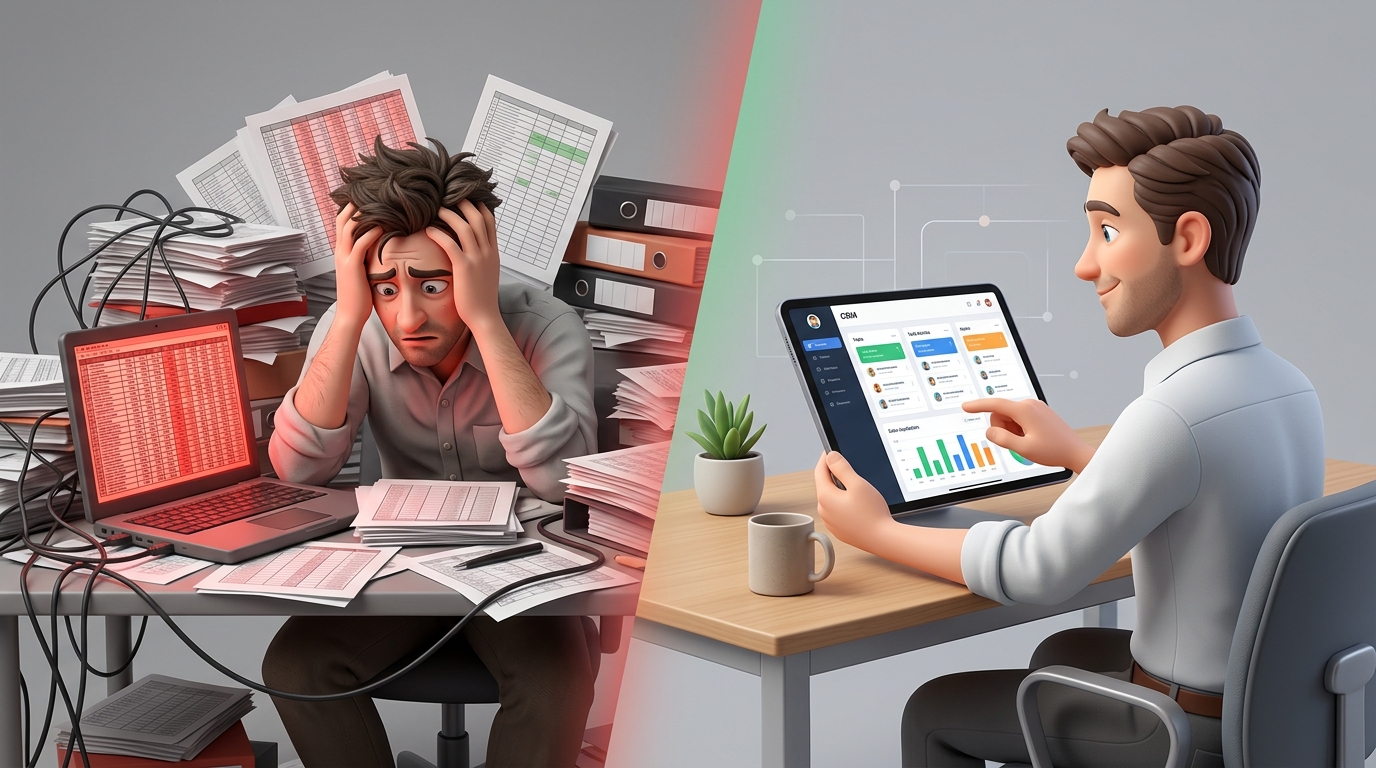
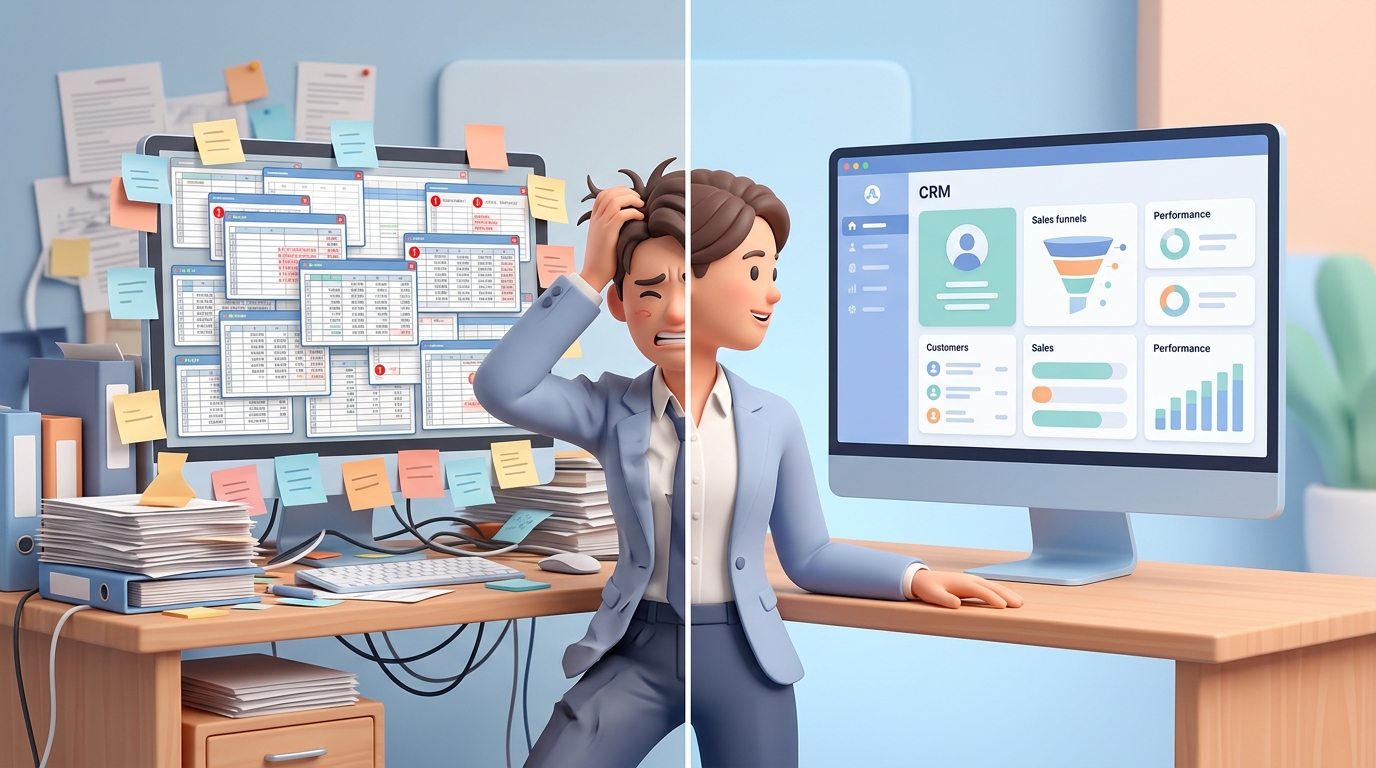
The “Before” Situation: A marketer launches an ad for a product that is out of stock because the warehouse updated the balance in Excel but didn’t notify the marketing department. Result: wasted budget and dissatisfied customers.
The “After” Situation (After Automation): The warehouse system is integrated with the advertising account. As soon as the stock reaches zero, the system automatically turns off the corresponding ad. Employees aren’t even involved in this process, which means they cannot make a mistake.
When Instructions Don’t Work: The Trap of “Oral Traditions”
Many managers try to cure errors by writing long regulations. But the problem is that people don’t read instructions in moments of stress or deadlines. Moreover, regulations become obsolete faster than you can print them.
- Problem: An employee acts according to an outdated scheme because they didn’t know about the changes.
- Problem: A new employee learns from an old one, picking up their bad habits and erroneous work methods.
- Problem: When a “star” employee resigns, they take all the knowledge of how the process works with them.
Automation turns an instruction into an algorithm. In a CRM system, a manager simply cannot move to the next stage of a deal until they fill in the required fields or attach the necessary document. The system becomes a “soft controller” that leads the person by the hand, preventing them from turning the wrong way.
Case #1: Logistics Company and API Magic
A company specializing in international transportation approached us. Their main pain point: managers constantly made mistakes in delivery addresses and cargo types when filling out customs declarations. Each such error cost between 200 and 1000 euros in fines or border delays.
What we did: We implemented a system that automatically pulls data from the client’s invoice and verifies it via the postal services’ API. Now, the manager doesn’t need to enter the address manually—they select it from a list already verified by the system. We also added an AI module that analyzes the weight and dimensions of the cargo and highlights it in red if the data looks illogical (for example, if the weight is specified in grams instead of kilograms).
Result: The number of errors in documents decreased by 92% during the first month. The company saved over 5000 euros on fines in just one quarter.
Case #2: Online Store and Stock Synchronization
A small furniture store had a problem: customers were ordering sofas that were no longer in stock. Managers couldn’t keep up with updating the Excel spreadsheet. This led to conflicts and refunds.
What we did: Implemented a CRM integrated with the warehouse program and the website. Now, as soon as an item is sold in the offline store, it instantly disappears from the website. If a client still wants to pre-order an item, the system automatically calculates the delivery date based on data from the manufacturer.
Result: Customer loyalty increased, and managers stopped wasting 2 hours a day making excuses to buyers and canceling orders.
How Automation and AI Change the Approach to Work
Modern automation is not just an “accounting program.” It is an intellectual environment that minimizes human intervention where it is weakest. Using artificial intelligence allows not only for fixing errors but also for predicting them.
Benefits of a Systemic Approach:
- Real-time Control: You see process bottlenecks before they lead to a catastrophe.
- Unleashing Creative Potential: Your people finally start thinking about how to sell more, rather than how to correctly fill in a cell in a table.
- Scalability: You can hire 10 new employees, and they will start working effectively by the second day because the system itself tells them what to do.
Conclusion: Invest in the System, Not in Control
Repeated mistakes are not a reason for anger, but a signal for action. Every time you see a staff “blunder,” ask yourself: “Can technology make this mistake physically impossible?” In 90% of cases, the answer will be “yes.”
Automation is not an expense; it is an investment in the stability of your business and your peace of mind as an owner. While your competitors continue to struggle with the “human factor,” you can build a system that works like a Swiss watch, regardless of the mood or fatigue of individual performers.
Want to get rid of errors in your business processes forever?
At Devorno, we specialize in creating solutions that make business transparent and manageable. We don’t just implement software—we analyze your pain points and create tools that work specifically for your results. If you’re tired of fixing the same mistakes, let’s talk. We will help you find the optimal path to automating your company.