0h2>Introduction: The Trap of “Irreplaceable” Staff
0p>Imagine a typical morning for a company owner, let’s call him Oleksiy. Oleksiy has built a successful business selling equipment. He has Serhiy — a “star” manager who has been with the company for seven years. Serhiy knows all the key clients, remembers all discounts by heart, knows who to call at the warehouse to speed up a shipment, and how to bypass bureaucracy when processing documents. Oleksiy is calm as long as Serhiy is there. But one day, Serhiy doesn’t get in touch. It turns out he decided to go to a competitor or simply burned out and wants to take a long vacation.
0p>At this moment, Oleksiy’s business stops. New managers don’t know where to start, clients are nervous because no one recognizes them by voice, and processes that previously seemed smooth turn out to be chaos held together by one person’s personal memory. This is a classic “high Bus Factor” situation — an indicator of how many key employees must be “hit by a bus” for the company to cease to exist.
0p>Staff dependency is not a compliment to your team; it is a critical vulnerability of your system. When knowledge belongs to people rather than the company, you don’t own your business — you rent it from your employees. In this article, we will analyze in detail how to escape this trap using automation tools, CRM, and proper process systematization. We will walk the path from chaotic “heroism” of individuals to the predictable operation of a digital system.
0h2>Why Does Employee Dependency Occur?
0p>Before treating a disease, you need to understand its causes. In most cases, business owners themselves create conditions where employees become irreplaceable. This happens due to a lack of standards and control tools. When every employee performs tasks “as they see fit,” the company loses a single quality standard.
0p>The main reasons for excessive dependency:
0ul>0li>0strong>Information Monopoly: Client data is stored in personal notebooks, Excel files on private laptops, or in employees’ messengers.
0li>0strong>Absence of Documented Processes: There are no clear instructions on what to do in situation A or B. Everything is decided “on the fly” thanks to the experience of veterans.
0li>0strong>Complex Technical Knowledge in One Head: Only one person knows how to set up a machine or how to correctly file a complex customs declaration.
0li>0strong>0Manual Management: The owner or manager is forced to personally confirm every step because the system cannot operate autonomously.
0/ul>0p>This creates a situation where 0em>business automation is perceived as something distant and expensive, although in reality, it is the only way out of the vicious circle of constant firefighting.
0h2>0Systematization as the Foundation of Freedom
0p>The first step toward reducing dependency is digitizing knowledge. You must extract knowledge from employees’ heads and transfer it to company ownership. This is done by creating SOPs (Standard Operating Procedures). These are not boring 50-page manuals that no one reads. They are clear, understandable action algorithms.
0h3>How Do SOPs Work in Real Life?
0p>Let’s look at an example from a service support department. 0strong>Before: A client calls with a problem, and only the experienced technician Petro knows that “you need to press the red button and then wait 5 minutes.” If Petro is away, the client waits for hours. 0strong>After: A knowledge base (Wiki) is created where any newcomer can find a 30-second video instruction using the keyword “error 404.” Result: Petro can handle complex tasks, and clients receive instant answers.
0p>To 0em>reduce dependency on employees, your instructions should answer three questions: What to do? How to do it? What result is considered successful? When you have such algorithms, training a new employee takes 3 days instead of 3 months. This makes staff interchangeable and the business resilient.
0h2>Automation: Turning Chaos into Algorithms
0p>Automation is not about replacing people with robots; it’s about freeing people from routine that a system performs better, faster, and without errors. The greatest dependency arises where there is a lot of human factor in data transfer.
0p>Consider three key directions of automation:
0h3>1. CRM System Implementation
0p>0CRM is not just a contact database. It is the “brain” of your sales department. When every call, email, and comment is recorded in the system, you no longer depend on a manager’s memory. If a manager leaves, another simply opens the client card and sees the entire interaction history for the last 3 years. 0strong>Process automation in CRM allows for setting up automatic reminders, sending commercial proposals, and controlling deadlines.
0h3>2. Automation of Internal Communications and Tasks
0p>Using task managers (Asana, Jira, Monday) instead of Viber chats allows you to see the real picture of the workload. You no longer ask “at what stage is the project?”; you simply look at the screen. This reduces dependency on whether an employee wants to answer you honestly or hide their mistakes.
0h3>3. System Integration (API)
0p>When your website automatically transfers an order to the warehouse program, and that transfers it to the delivery service, you eliminate “Lyudmyla from accounting” who used to re-enter this data manually and often made typos. 0em>Business process optimization through integration removes entire links of potential errors.
0h2>0Case #1: Sales Department without “Stars”
0p>Consider a company engaged in wholesale construction materials. They had 3 top managers who brought in 80% of the revenue. They dictated terms to the owner, demanded excessive bonuses, and worked on their own schedules. The owner was afraid to fire them because “they would take the clients.”
0p>0strong>What was done:
0ul>0li>Implemented a CRM with strict lead logging.
0li>0Set up IP telephony (all conversations are recorded).
0li>0Developed sales scripts and an automatic discount system calculated by the program, not the manager.
0li>0Introduced a lead generation system where clients come through marketing rather than managers’ personal connections.
0/ul>0p>0strong>0Result: When one of the “tops” left, his client base remained with the company. A new manager, using the CRM history and ready-made scripts, reached target performance indicators in 2 weeks. Dependency on specific names disappeared; dependency on system quality remained.
0h2>0Case #2: Logistics without “Irreplaceable” Dispatchers
0p>0A transport company with 50 trucks depended on two dispatchers who knew all routes and drivers. Only they could say where a truck was and when it would arrive. It was constant stress and 24/7 calls.
0p>0strong>What was done:
0ul>0li>Installed GPS trackers on all vehicles with integration into a single monitoring panel.
0li>0Implemented an automatic request distribution system based on geolocation.
0li>0Created a client portal where customers can see the cargo status themselves.
0/ul>0p>0strong>0Result: The dispatcher’s role was reduced to monitoring deviations from the norm. The number of errors due to “forgot to pass it on” decreased by 90%. The company was able to scale to 100 trucks without hiring new dispatchers.
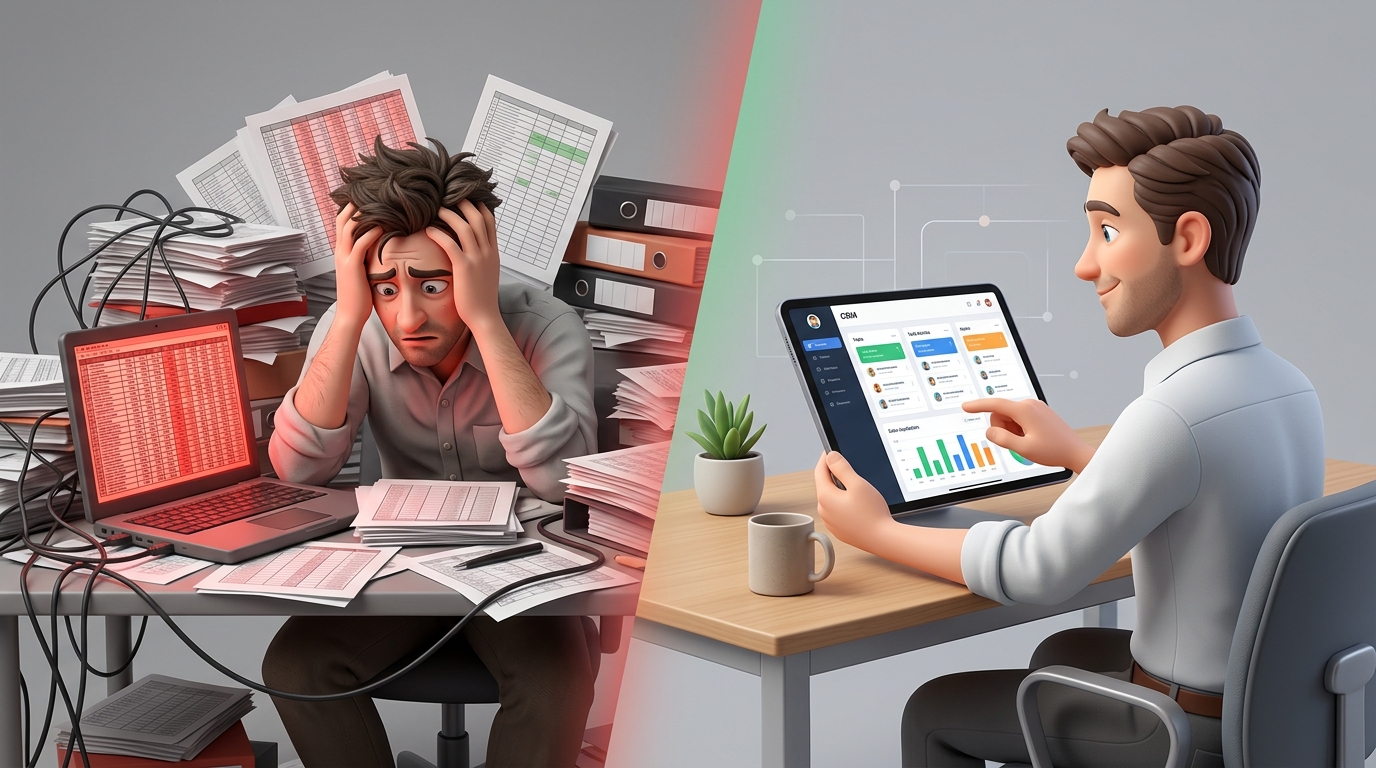
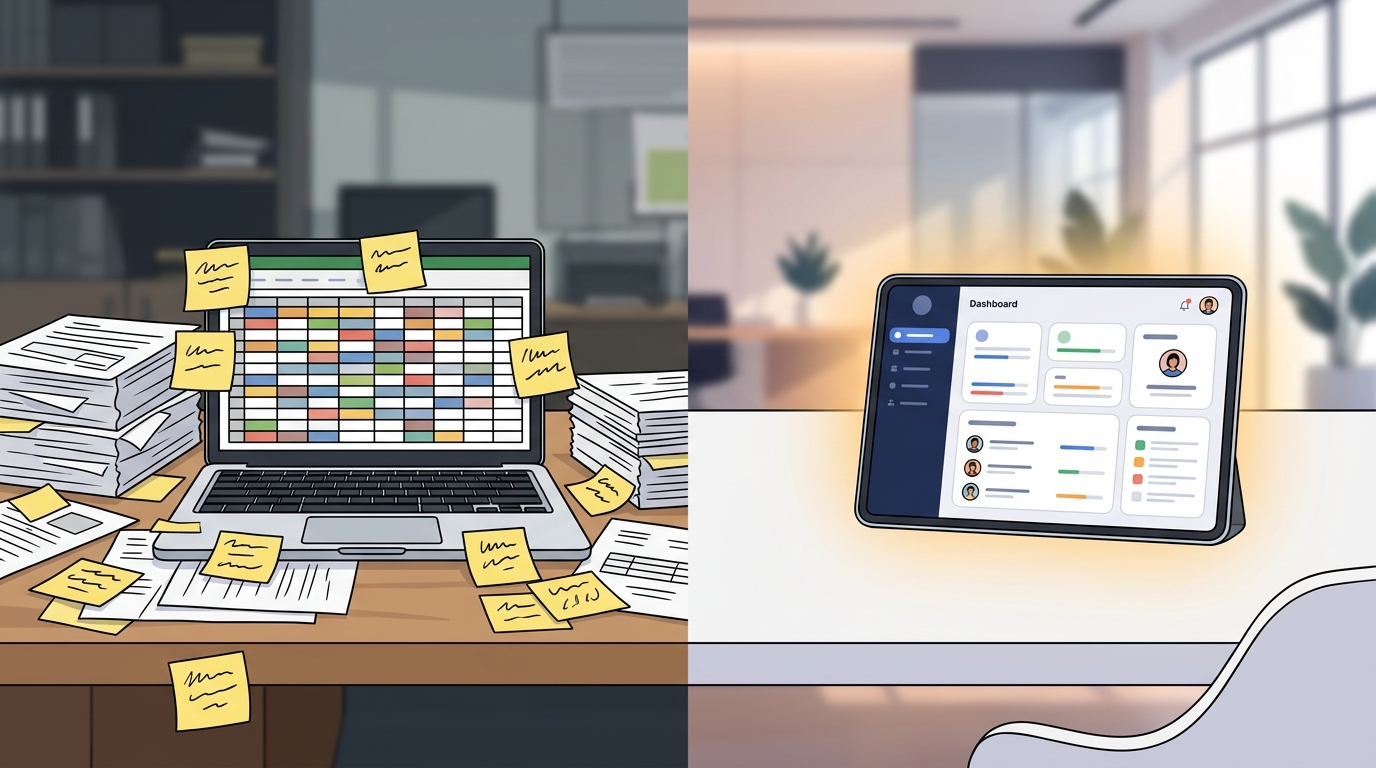
0h2>Comparison: Manual Management vs Systemic Business
0p>0Let’s compare the two approaches by key parameters:
0ul>0li>0strong>Data Storage: In manual mode — heads, papers, Excel. In systemic — cloud CRM/ERP with access rights.
0li>0strong>0Training Newcomers: In manual — “sit next to the experienced one and watch.” In systemic — online course, tests, knowledge base.
0li>0strong>Quality Control: In manual — selectively based on the manager’s mood. In systemic — automatic reports and real-time KPIs.
0li>0strong>0Scaling: In manual — impossible without chaos. In systemic — copying successful processes to new branches.
0/ul>0p>As we can see, 0em>business systematization is not just about convenience; it is a matter of survival and growing your capital.
0h2>0The Role of Artificial Intelligence (AI) in Modern Automation
0p>We live in an era where AI is becoming another tool to reduce dependency on people. Today, AI can perform the work of entire departments:
0ul>0li>0strong>0Customer Support: Smart GPT-based chatbots answer 80% of typical questions as well as an operator.
0li>0strong>Analytics: AI can analyze thousands of sales rows and suggest which products to buy instead of relying on a buyer’s “intuition.”
0li>0strong>0Copywriting and Content: Creating product descriptions or newsletters now takes seconds.
0/ul>0p>Implementing such tools makes your business a technological leader and further reduces risks associated with the human factor.
0h2>Conclusion: Your Strategy for Exiting Operations
0p>0Reducing dependency on employees is a path that requires the owner’s will. Initially, you may face resistance from the team, as “irreplaceability” is a form of power for an employee. They might say “it’s too complicated” or “it won’t work in our specific case.” Don’t believe them. Any process repeated more than twice can be described and automated.
0p>0Remember: your goal is to create a machine where every part (employee) is high-quality but replaceable. This doesn’t mean people shouldn’t be valued. On the contrary, in a systemic business, talented people can focus on creativity and development rather than filling out identical spreadsheets. 0strong>0CRM automation and other processes give your team better tools to achieve results.
0p>If you feel your business is held together too tightly by specific people and you fear their vacations or resignations — it’s time to act. Start with an audit of current processes: where is the biggest bottleneck? where is information lost most often?
0p>At Devorno, we specialize in turning complex business tasks into simple and effective digital solutions. If you want to build a system that works like a clock, regardless of who came in for the shift today — we are ready to help. We will analyze your processes, select the right tools, and help implement them into your company’s life. Let’s make your business truly yours.