
0h2>А Monday Morning That Changes Everything
0p>Imagine an ordinary morning. You enter the office or open the work chat, and your key employee — let’s call him Andriy — asks for a short talk. Andriy has been working with you for five years. He knows all the clients by name, remembers the specifics of every purchase, keeps complex logistics chains in his head, and personally manages the most profitable projects. 0em>”I’ve decided to move on,” he says. At this moment, many business owners’ hearts skip a beat.
0p>This is not just the loss of a good person. This is the beginning of a systemic crisis. Why? Because along with Andriy, a massive amount of information that isn’t recorded anywhere leaves the company. His personal Excel sheets, conversations in personal Telegram chats, “secret” agreements with suppliers — all of this disappears. You suddenly realize that your business relied not on a system, but on the memory and diligence of one person. This is a critical vulnerability known in management as the 0strong>”bus factor”.
0h2>What is the “Bus Factor” and Why Does It Threaten Your Profit?
0p>The term “Bus Factor” describes the number of team members who, if “hit by a bus,” would cause the project or business to stop. If you have processes known by only one person, your bus factor is one. This is the most dangerous scenario for any company.
0p>When such an employee leaves, you face three main problems:
0ul>0li>0strong0Loss of institutional memory: Why do we do things this way? What mistakes have we already made? Without documentation, every new employee will “step on the same rakes” again.
0li>0strong0Process paralysis: Clients call asking for the discount Andriy promised, and you don’t even know what they’re talking about. Suppliers delay goods because only Andriy knew how to “nudge” them.
0li>0strong0Lowered morale: Other employees see the chaos and start to get nervous, increasing the risk of a “chain reaction” of resignations.
0h2>Financial Consequences: How Much a “Star” Resignation Really Costs
0p0Most owners only count recruiting costs (HR services, ads). But this is just the tip of the iceberg. Let’s calculate the real losses. According to research, the cost of replacing a mid-to-high level specialist ranges from 150% to 200% of their annual salary.
0p>0strong0Real Business Example (Logistics): A dispatcher-logistics officer worked in a company, manually managing a database of 50 carriers. Everything was in his notebook and head. When he left for a competitor, the company lost 15% of orders in one month due to the inability to quickly find available transport at a fair price. The new employee spent 3 months just re-establishing contacts the company already had. Total losses exceeded 400,000 UAH in lost profit alone.
0h30Scenario Comparison: No Automation vs. With Automation
0p>Consider two scenarios of a sales manager’s resignation:
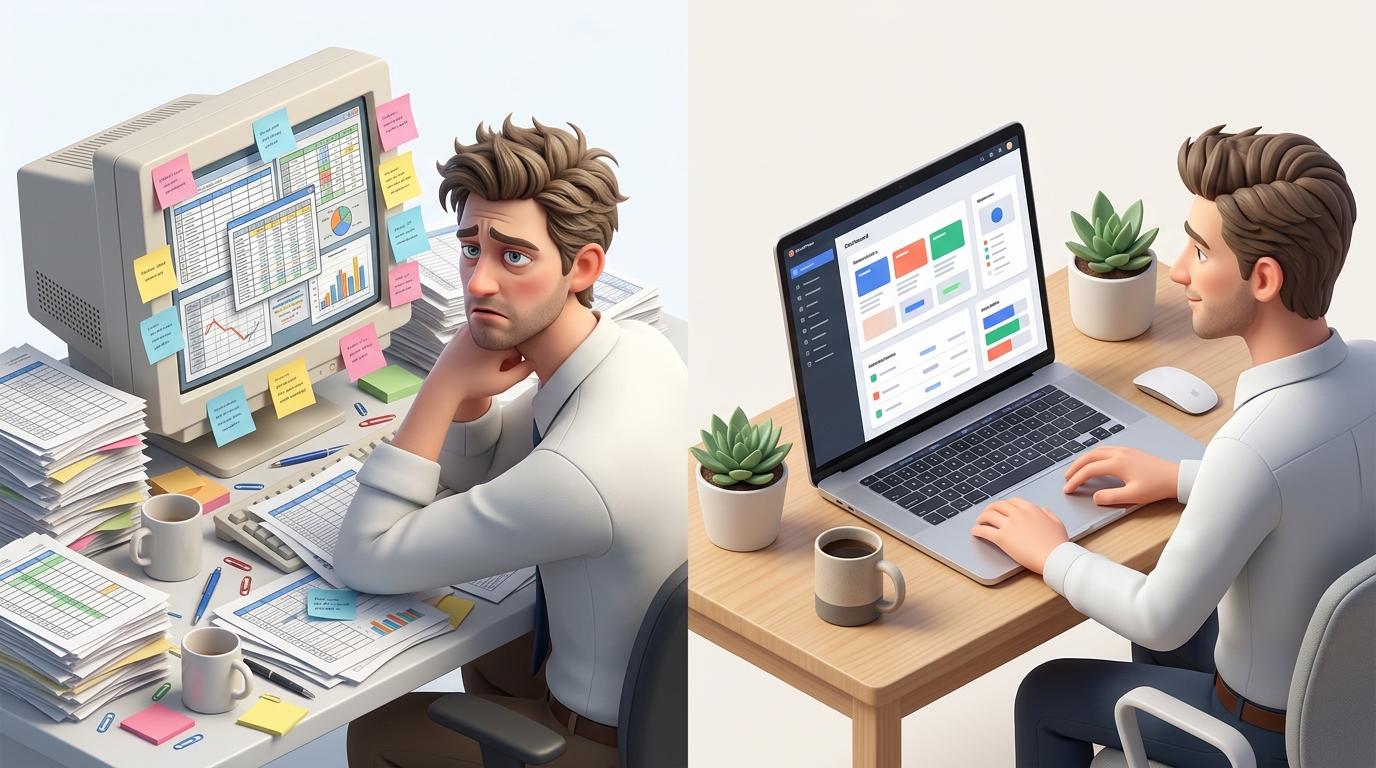
0p>0strong0Before (Manual Management): The manager leaves, deletes messenger chats, and takes the contact list. You don’t know the status of negotiations for a 1 million UAH deal. The client is offended that no one called back and leaves. You lose money and reputation.
0p>0strong0After (CRM Implemented): The manager leaves. You simply block their system access. The CRM retains the full history: call recordings, email copies, notes on client preferences. A new manager opens the file, reads the history in 10 minutes, and continues the conversation exactly where it left off. The client doesn’t even notice the change.
0h20Case #1: How a Manufacturing Company Saved Its Sales Department with CRM
0p0A company manufacturing metal-plastic windows had a staff of 5 managers. Everyone worked “how they liked”: some in Excel, some in notebooks. When the lead manager went on maternity leave, it turned out that over 30% of potential clients were simply “hanging.” No one knew who needed a callback or who had already been sent a technician for measurements.
0p>0strong0Solution: CRM implementation and sales funnel automation. We set up automatic task creation. Now every action is recorded. When another manager resigned six months later, handing over their cases to a new employee took exactly 2 hours. Result: lead-to-sale conversion grew by 12% because no lead is lost anymore.
0h20Case #2: Service Center Automation and Artificial Intelligence
0p0A large service center depended on one senior master who knew all the technical nuances of repairing rare equipment models. When he decided to start his own business, the company faced the threat of closing that department.
0p>0strong0Solution: Creating an internal knowledge base (Wiki) and implementing an AI assistant. All unique repair cases began to be recorded in the system. Artificial intelligence analyzed these records and helped newcomers find solutions based on key symptoms. Now the expertise belongs to the company, not a specific person. Dependency on the master’s “unique knowledge” decreased by 80%.
0h20How Automation (CRM, ERP, AI) Turns Chaos into a System
0p0Automation is not just a “computer program.” It is a strategy for transferring intellectual property from employees’ heads into company assets. When you implement modern IT solutions, you are buying peace of mind.
0h30CRM as a Collective Brain
0p0A CRM system gathers everything: from a client’s first click on the site to the final payment. It doesn’t get sick, doesn’t resign, and doesn’t go to a competitor. It is the foundation upon which the sales department stands.
0h30Artificial Intelligence for Preserving Experience
0p0Today, AI can analyze thousands of dialogues from your best employees and form an “ideal model” of behavior for newcomers. This allows you to scale the business without losing quality, even if the team composition changes.
0h20Action Plan: What to Do Today to Sleep Soundly
0p0If you feel your business is too dependent on specific people, start acting immediately:
0ul>0li>0strong0Conduct a knowledge audit: Ask yourself what happens if the head accountant, manager, or technician leaves tomorrow. What information disappears with them?
0li>0strong0Implement CRM: Stop allowing clients to be managed in personal messengers or notebooks. Every interaction must be in the system.
0li>0strong0Digitalize processes: Create regulations and instructions. Every repeatable action should have a description: “how to do this.”
0li>0strong0Use cloud solutions: Access to work files must belong to the company, not an employee’s personal laptop.
0h2>Conclusion
0p0A key employee’s resignation is always unpleasant, but it shouldn’t be a catastrophe. The difference between a successful business and one constantly fighting for survival lies in the presence of a system. Process automation through CRM and AI solutions is your insurance policy. It guarantees that knowledge, clients, and money stay with you, regardless of who decides to leave the team.
0p0Don’t wait for your “Andriy” to come with a resignation letter. Start building a system that works independently of personalities right now. This is an investment that pays off not just in money, but in your peace of mind and the ability to scale without fear.
0p>If you feel your business relies on the “heroism” of individuals and want to change that — we at 0strong0Devorno are ready to help. We specialize in CRM implementation and automation that makes business resilient to any personnel changes. Let’s discuss how to make your company independent and stable.